Applying for exceptional admission to residence is an ordeal in which your fear of refusal mingles with the exhaustion of waiting. On French territory, your procedure demands unfailing patience in the face of a complex administrative system. This article details for you how to transform each of your supporting documents and payslips into a complete file for the prefecture. We will see that being supported by an immigration lawyer in Paris allows you to lift certain administrative blockages through appeals targeted on the basis of the CESEDA. Discover your eligibility criteria and the average time to obtain your permit in 2026.
Definition and principles of the AES: what you need to know before submitting your file
This is not a procedure like any other: before acting, you need to understand what you are facing.
The legal nature of the AES: a discretionary power of the prefecture
Exceptional admission to residence is a derogatory procedure allowing a foreign national in an irregular situation to obtain a residence permit. It is not a mechanical procedure in which a complete file automatically guarantees a positive response. The prefect has discretionary power: they assess your situation in its entirety and can refuse even if the basic criteria are met. This is not an injustice of the system, it is how it legally works. Understanding this from the outset changes the way you must prepare your application: every supporting document, every document, every detail counts.
The legal framework: which articles of the CESEDA govern exceptional admission to residence?
Exceptional admission to residence is governed by the CESEDA (Articles L. 435-1 et seq.). Since 23 January 2025, new ministerial guidelines have replaced the 2012 Valls circular, tightening the criteria for assessing integration and presence on the territory. Furthermore, the law now allows, via Article L. 435-4, a specific regularisation for shortage occupations without the employer’s approval, an arrangement in force until the end of 2026.
Unlike a classic residence permit renewal, here there is no obligation for the administration to issue you the requested permit, even if your file is complete. This point changes the entire way you must prepare your application.
What are the eligibility criteria for the AES in 2026?
Three broad situations open the way to this procedure.
Uninterrupted presence on the territory: the foundation of any application
Whatever your situation, the first thing the prefecture will look at is how long you have really been in France, and whether you can prove it. The general threshold applied is 7 years of uninterrupted presence on French territory. Depending on your grounds for application, this threshold may drop to 3 or 5 years.
Each year must be justified by at least one dated document: a rent receipt, an invoice, a payslip, a school enrolment certificate, a bank statement. A single gap in the chronology can weaken the entire file. Consider putting together a binder with a tab for each year, from the oldest to the most recent.
FOCUS: ALGERIAN NATIONALS
Your situation is distinguished by bilateral agreements between France and Algeria. The classic AES procedure does not apply in the same way to your nationality. It is essential to check this point before taking any steps.
Regularisation by the AES on “Private and family life” grounds (VFP)
These grounds are intended for persons whose intensity of personal and family ties in France makes a return to the country of origin disproportionate. Since the repeal of the Valls circular, the criteria are now governed by the ministerial guidelines of January 2025 (Retailleau circular), which require proof of reinforced integration.
- Parents of children in school: you must demonstrate a minimum presence of 3 years on the territory. The child’s schooling (often 3 years as well) remains a key indicator, but the new circular places heavy emphasis on the “effective contribution to the maintenance and education” of the child. The State services now closely scrutinise your command of French and your adherence to the values of the Republic. An active integration path (volunteering, language certifications) has become indispensable to offset the exceptional nature of the application.
- Spouse of a person in a regular situation: the general rule has tightened: a residence of 5 years in France is expected, coupled with a stable and proven shared life of at least 18 months. Marriage or a PACS civil partnership are no longer sufficient on their own; the administration requires indisputable proof of a “material and emotional community of life” (joint accounts, leases in both names, shared bills).
Undocumented workers: the AES for shortage occupations
If you work in France without a residence permit in a sector that struggles to recruit (construction, catering, personal care, transport, etc.), a specific regularisation route is open to you until 31 December 2026.
Article L. 435-4 of the CESEDA allows you to apply for your residence permit without needing the agreement or signature of your employer. It is the Prefect who decides alone on your regularisation after examining your background.
To benefit from this arrangement, you must meet three cumulative conditions:
- Residence in France: demonstrate an uninterrupted presence of at least 3 years on the territory.
- Professional activity: prove that you have worked at least 12 months (consecutive or not) over the last 24 months in an occupation appearing on the official list of “shortage occupations“.
- Current employment: be carrying out, at the time of the application, an activity in one of these sectors.
Furthermore, since the circular of 23 January 2025, the administration also requires a verification of your social integration and your respect for the values of the Republic. Your level of French can also be a determining factor in the Prefect’s discretionary decision.
Do not give up on your AES application if your occupation is not a “shortage” one: simply favour Article L. 435-1 instead of L. 435-4 to assert your exceptional situation.
Humanitarian situations and special cases
Certain situations do not fall into any of the previous boxes but can nevertheless open a route to regularisation. This is the case in particular for:
- young people reaching the age of majority: if you have resided in France since the age of 16 and can demonstrate a serious academic record, you can apply for exceptional admission to residence. Once regularised, you can then claim a 10-year resident card after several years of regular presence.
- serious humanitarian situations or exceptional civic commitments can also be invoked. This is the case, for example, of a person whose return to their country of origin would expose them to a documented real danger, without however coming under refugee status.
- foreign nationals who have become significantly involved in local life: active volunteering in a recognised association, a mediator role in their municipality, and lasting involvement in a public-interest service.
These elements are not sufficient on their own, but they can tip the balance when they are well presented. In these cases, no figure-based criterion is set in advance. The prefect assesses on a case-by-case basis, which makes these files particularly delicate to put together without legal support.
How to build a solid AES file to convince the prefecture?
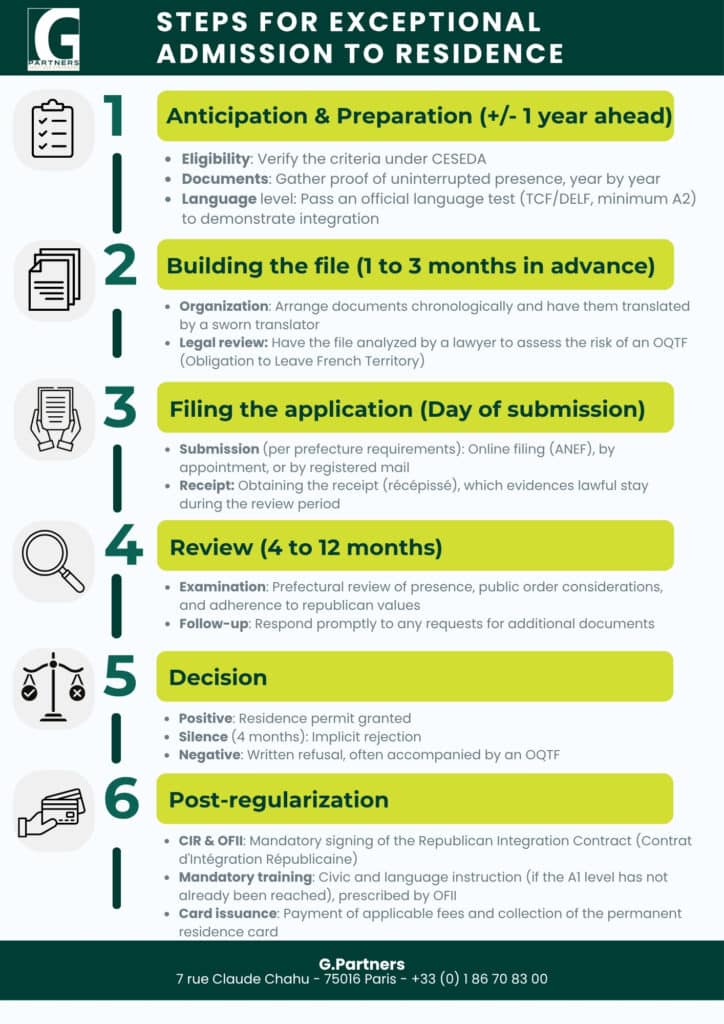
A well-prepared file is your best argument.
The list of indispensable supporting documents
Although the precise list may vary according to the type of application and from one prefecture to another, a core set of documents is systematically required for your AES application to be examined, whatever the grounds:
- Identity and civil status: a copy of your passport (even if expired) or any document proving your nationality. Your birth certificate must be accompanied by a translation carried out by a sworn translator with a French Court of appeal. An untranslated document may be set aside.
- Proof of presence: you must prove your uninterrupted residence in France, year by year. Favour “certain proofs” (tax assessment notices, AME documents, CAF statements) over “simple proofs” (prescriptions, personal letters).
- Documents according to your grounds:
- private and family life: your children’s school enrolment certificates, proof of a community of life (lease in both names, shared bills) or of emotional ties in France.
- work (shortage occupations): your last 12 payslips over the last 24 months. Note that for Article L. 435-4, the employer’s CERFA form is no longer mandatory: you can submit your file on your own.
- Stability and integration: recent proof of accommodation, health insurance attestation, and, increasingly, proof of your command of French (training certificates, diplomas).
If a supporting document is missing for a given period, never leave a chronological “gap” without an explanation. Look for duplicates or replace the missing document with an alternative document (bank statement, transport attestation) to guarantee the continuity of your file.
Where and how to submit your application: ANEF portal or prefecture desk
The submission procedure varies from one prefecture to another. In some departments, everything is done online on the gouv.fr site via the ANEF (Digital Administration for Foreign Nationals in France). In others, a physical appointment is necessary. Obtaining this appointment is sometimes in itself an uphill battle: slots are scarce, the waiting times sometimes very long. It can be useful to obtain the help of a lawyer for a prefecture appointment.
Read carefully the explanatory notice attached to each form before filling it in. A wrongly ticked box or a forgotten document can lead to the rejection of your file on grounds of incompleteness, which further pushes back the processing times.
If you are stuck at this stage or faced with silence from the administration, a lawyer expert in immigration law can intervene directly to facilitate the processing of your file.
The acknowledgement of receipt and the processing times to anticipate
Once your complete file is submitted, the prefecture issues you an acknowledgement of receipt of the residence permit application. This document proves that your procedure is duly registered and authorises you to reside legally in France during processing.
The acknowledgement of receipt does not automatically give you the right to work or to leave French territory. The rights granted depend on the grounds of your application.
The average processing time can vary from a few months to more than a year, depending on the prefecture and the complexity of your personal situation. In Paris or Bobigny, the times are often longer than in the provinces.
The mistakes to avoid so as not to jeopardise your AES application
A poorly prepared file almost always results in an OQTF (Obligation to Leave French Territory).
Why do refusals happen and how can they be anticipated?
- Break in the continuity of presence: a single “blank” year (without any dated administrative or medical proof) allows the prefecture to consider that your stay was not uninterrupted. The new circular of January 2025 requires absolute vigilance on this point.
- Threat to public order and criminal record: since the 2024 law, the tolerance threshold is almost nil. A conviction, even an old one, or behaviour deemed contrary to the principles of the Republic (new mandatory commitment contract) justifies an immediate refusal.
- Employer in breach of the law: if your company has tax or social debts, or if it has already been sanctioned for undeclared work, your application will be rejected, even if you are in good faith.
- Prior OQTF: if you have already received an OQTF less than 3 years ago and have not enforced it, the prefecture may refuse to examine your new file (except in exceptional humanitarian circumstances).
A refusal of residence is never neutral. In 2026, the law almost systematically requires the prefect to accompany their refusal with an Obligation to Leave French Territory (OQTF). Depending on the seriousness of the file (fraud, threat to public order or simply an incomplete file), a refusal can directly lead to an OQTF without a time period, that is, an obligation to leave French territory with no time to organise your departure.
It is vital to have your file analysed by a lawyer before taking any steps in order to measure this risk of “crystallisation” of the refusal.
Best practices to secure your procedure
A few simple reflexes can make a real difference in the processing of your file.
- The “social health” of your employer: in 2026, the prefectures systematically cross-check their records with the URSSAF. If your employer has social debts or has been sanctioned for undeclared work, your application will be rejected. Before submitting, make sure your company is up to date with its contributions: a simple URSSAF vigilance attestation can reassure you about the viability of your procedure.
- The digital “proof of life”: the prefectures increasingly appreciate proof of your digital and social integration. Keep your account statements (which prove a physical presence through card payments), your transport passes (Pass Navigo or other) and your volunteering attestations.
- Secure Cloud archiving: in addition to the physical binder, create a digital folder (Google Drive, Dropbox) shared with your lawyer. In the event of an identity check or the loss of the binder, you must be able to access all your proofs in one click from your phone.
- Consistency of addresses: make sure that the address appearing on your payslips, your tax documents and your bills is the same for a given period. An unexplained discrepancy is often perceived as an attempt at fraud or as instability.
- Checking the “Commitment Contract”: since 2025, you must sign a commitment to respect the principles of the Republic. Make sure that your social networks or your public activities contain nothing that could be interpreted as an opposition to these values, as the administration may carry out checks.
- The anticipated language level test: do not wait for the prefecture to ask you for it. If you have an A2 or B1 level in French, take an official test (TCF or DELF) before submitting. It is a strong signal of integration that can tip the prefect’s decision in your favour.
And above all, do not wait until you are in a crisis to act. The more you anticipate your procedure, the more time you have to complete your file without haste.
If a document has disappeared (a birth certificate, an old permit, an attestation), react without delay. A missing supporting document can always be reconstituted or replaced. An abandoned file, never.
Why entrust your exceptional admission to residence application to the G-Partners firm?
This administrative process is exhausting. You do not have to go through it alone.
The expertise of an immigration lawyer: an asset against the risk of refusal
Exceptional admission to residence rests on the discretionary power of the prefect. This means that there is always a margin of interpretation, and it is precisely within this margin that a lawyer specialising in residence permits in Paris can act. They do not change the rules, but they know the arguments that work, the documents that tip the balance, and the appeals available if the response is negative.
In the event of prolonged silence from the administration beyond a reasonable period, a contentious appeal before the administrative court can be lodged.
If you are subject to a removal measure accompanied by an IRTF (Ban on Returning to French Territory), this decision can be challenged. And if your situation is complex, a defence strategy can be built even before you submit anything.

Tailored support, from the first appointment through to regularisation
Each exceptional admission to residence file is unique. That of a father present for 9 years with two children in school does not resemble that of a care assistant with 5 years of payslips in the medical sector. A generic strategy is not enough.
The G-Partners firm intervenes at every stage:
- analysis of your eligibility,
- building and verification of your file,
- representation at the prefecture,
- appeal in the event of a refusal,
- and support for the next steps, whether it is a renewal or a resident card application.
The objective is always the same: to secure your procedure before you make yourself known to the administration.
Have you suffered a refusal, or do you not know where to start?
Get in touch with the G-Partners firm today to build together an action plan suited to your personal situation.